The reporting structure to which the enterprise architect belongs, as well as the governance model, have a significant influence on the role of the Enterprise Architect. CA recommends a shift toward a more business-oriented role and a systemic thinking perspective.
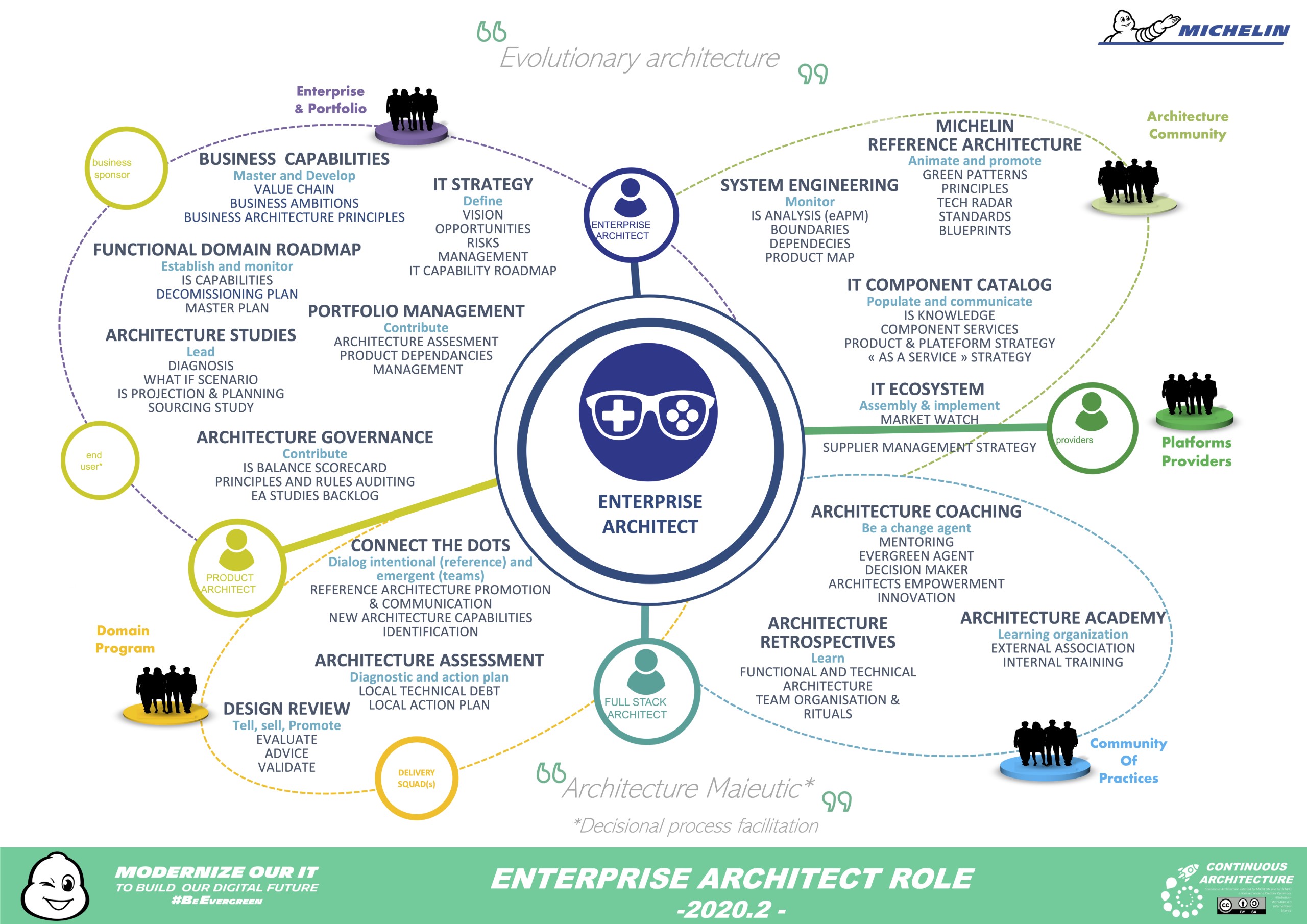
Enterprise Architect as an IT role
In companies that continue to be influenced by the TOGAF 9.2 model of the Open Group, an Architecture Board under the supervision of the CIO defines the framework within which architectural decisions are made.In these companies, the role of Enterprise Architect is viewed—particularly by the business side—as an IT role.The core responsibilities of the Enterprise Architect are:
Understand and interpret requirements.
Formulate an architecture vision and create/evolve the supporting enterprise architecture model which is comprised of the business, data, application and technology architectures.
Act as an agent of change and evolve the enterprise architecture model as needed.
Enterprise Architecture in a digital world
In a digital world, aligning IT with business strategy has shortcomings, because business decisions must take into account technological and architectural considerations. The Bezos mandate illustrates this. This was a set of strict directives sent to all Amazon employees, requiring a complete shift in how software was built and how teams interacted. It consisted of 6 points:
Expose all data and functionality: All teams must expose their data and functionality through service interfaces (APIs).
Communication only via APIs: Teams must communicate with each other exclusively through these interfaces.
No “backdoors”: No other form of interprocess communication is allowed: no direct linking, no direct reads of another team’s data store, no shared-memory models, and no “backdoors.”
Technology agnostic: It doesn’t matter what technology or programming language is used.
Designed to be externalizable: All service interfaces, without exception, must be designed from the ground up to be externalizable. This means teams had to plan and design as if the interface would eventually be exposed to developers in the outside world.
The consequence: “Anyone who doesn’t do this will be fired. Thank you; have a nice day!”.
Not all Enterprise Architects are “Jeff Bezos.” However, the central role that technology now plays in digital businesses highlights the need to evolve the role.
Enterprise Architect in Continuous Architecture
An Enterprise Architect (EA) is a a business leader with deep technological roots. Instead of formal authority, they lead through super-knowledge and influence. Key Characteristics of the Role
- Voice of the Customer: The EA spends significant time understanding what customers and other stakeholders actually need.
- System Architect: They don’t just design parts; they define the concept of the entire system or system of systems with an ecosystemic perspective. They ensure that every organizational, human and technology component works in harmony to deliver the expected experience at the expected cost.
- Technology Mastery: They are not expected to be the best in every discipline. They are expected to know enough in each dicipline elicit productive conversations and challenge engineers and experts to help make effective trade-offs and prevent compromises that could jeopardize the ability to meet business intent and objectives.
- Entrepreneurial Mindset: They are innovation agents that help the enterprise develop and sustain lasting competitive advantages.