Product
Defining terminology is a useful starting point when reading or writing on a subject to prevent any confusion or assumptions. We will use the term “Product” to refer to a named collection of business capabilities valuable to a defined customer segment 1. As Gartner observes “Although products (in the context of digital business) principally serve external customers, software organizations can also apply a product model to any collection of business capabilities delivered in a coherent value stream to internal customers”. Products are goods and/or services that can be tangible (tire, smart phone, workstation, …) or intangible (mortgage loan, automobile insurance, email service, …). Products meets clients’ needs as captured in the Experience Objectives view.
The most important consideration when defining products is to clearly articulate and understand the concept of “customer” as the products we create, manage and maintain ultimately exist to deliver essential capabilities for them. The “customer” here can be: an external customer or consumer or an internal customer such as an employee or a developer. The term end-user is also used to refer to who uses a product although an end-user is not always the person or entity who pays for the product.
Product provides a set of services / features delivered to it’s community of end-users through continuous flow of releases, during all it’s life cycle, from ideation to retirement, in order to continuously deliver value and enable continuous change & agility.
It’s a way of organizing cross-functional agile teams around a continuous stream of value rather than a “one-off” temporary organizational structure. Even if there is a high level of variability in defining what is a product, there are common attributes and guidelines to consider when defining what is and is not a product:
- can serve external or internal external customers
- is clearly defined by its business capabilities
- delivers capabilities to a defined customer segment
- can be a repeatable service
- can be a platform, for example one-sided or multi-sided
- can be bought, sold, subscribed and/or funded
- has competition and follows a product lifecycle
Digital products are materialized by one or several software and/or hardware components and its related production and services processes. It is a mistake to think that a product equals an application as defined historically. It could be but this is not always the case.
A product team is responsible for all product development and delivery activities during the whole product lifecycle (from ideation to retirement). These teams are cross-functional, self-organized, have dedicated members, long-lived, and co-located when possible. Specifically cross-functional means having all the skills required to fulfill their mission with a mix of IT and business people; they are focused and measured by outcomes (rather than output); and they are empowered to figure out the best way to solve the problems of their customers.
The purpose of a product team in this sense is to solve problems in ways our end-users love, yet work for our business.
Usually a product team is a squad (5-10 people), but can be a Squad of squads or Tribe for big products. The size of a product team or the product’s portfolio a team manage can vary over time time.
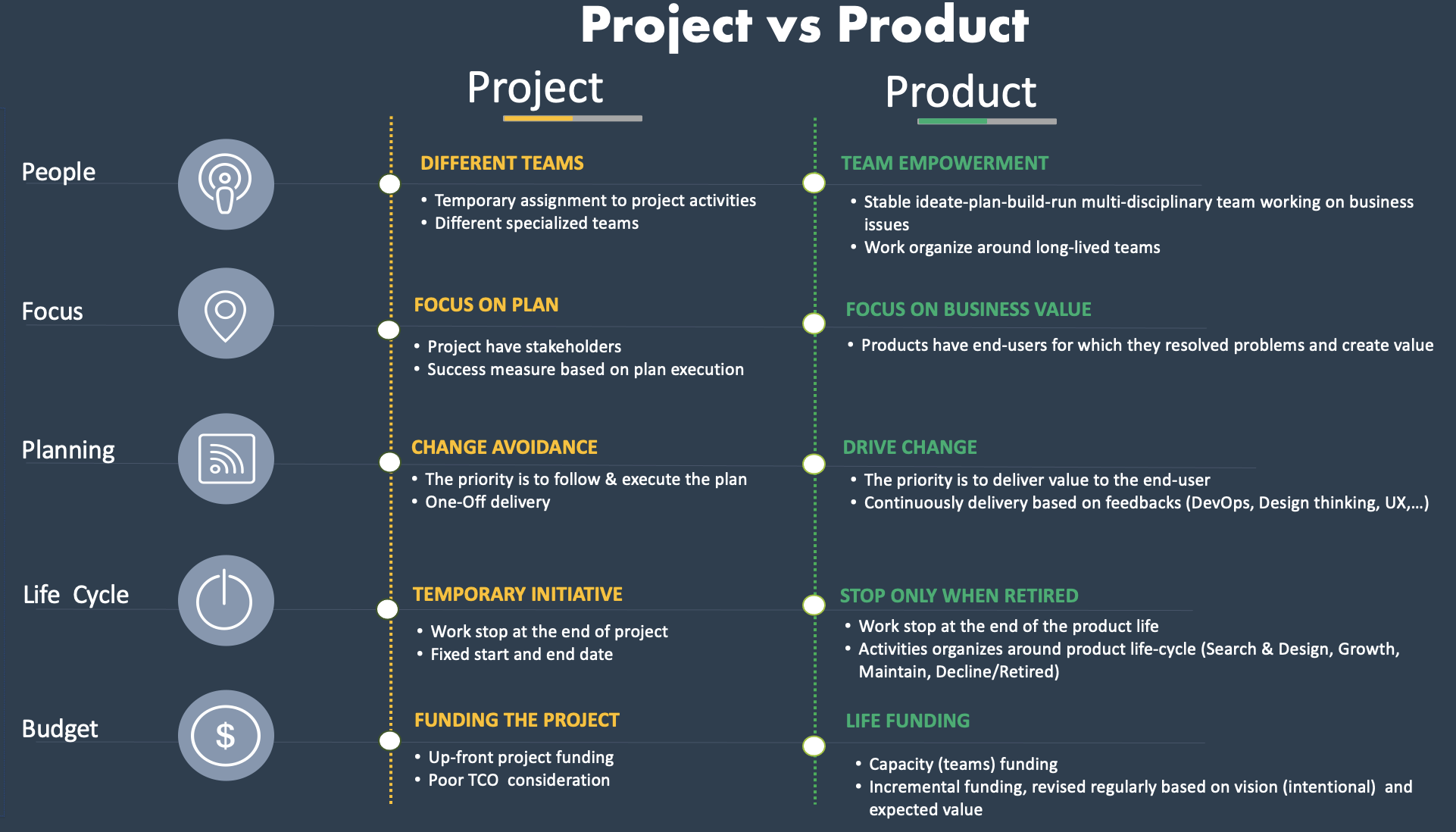
To get all the benefits from product team, you should consider adopting the product mindset over the traditionnal project approach for your organization. We got our inspiration here from an article wrote by Sriram Narayan and published on Martin Fowler’s web site. We created this visual to show the differences between the two approaches: